

*Our business operating hours are from [8:00-17:30, Monday through Saturday]. We will contact you within 24 hours. Please keep an eye on your messages.
XF-7 Food Grade Plastic Tray for Food Handling and In-Process Transport
2026-09-19 10:03:06
Click:
“
Explore the confirmed 490 × 337 × 85 mm XF-7 food grade plastic tray, its role in turnover and internal transport, and the details buyers should provide when requesting a quotation.
”
Food processing operations often need a practical way to organize, hold, and move materials between workstations. A deep container is not always the most convenient choice, especially when workers need clear visibility and frequent access to items during sorting, preparation, inspection, or packing. A shallow rectangular plastic tray can support these workflows by keeping contents easy to see and reach.
The Xingfeng Plastic XF-7 tray is a blue, open-top food grade tray designed for turnover and transport applications. Its confirmed external size is approximately 490 × 337 × 85 mm. The low-profile format makes it relevant to food-related handling tasks where materials are arranged in a single layer or transferred over short internal distances.
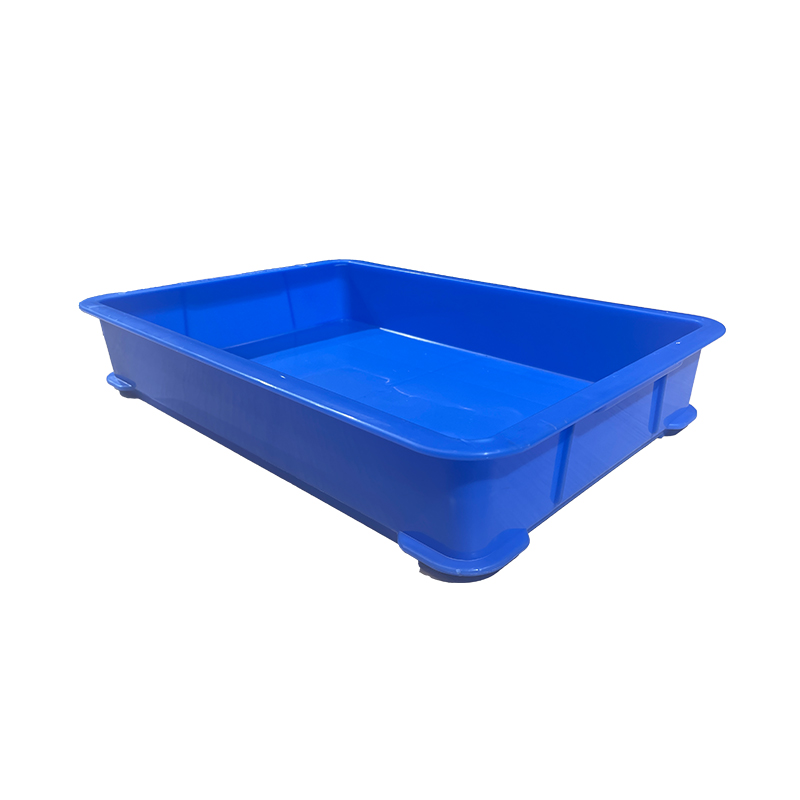
XF-7 blue food grade plastic tray product photo
Why Use a Shallow Plastic Tray in Food-Related Workflows?
Internal food handling usually involves more than one step. Ingredients, protected semi-finished goods, packaged items, and auxiliary materials may move from preparation to inspection, temporary holding, or packing. When a container is relatively shallow, the operator can view the contents without reaching deeply into the container. This can make routine picking, sorting, and workstation handoffs more straightforward.
The XF-7 has a rectangular open-top body, a surrounding rim, and four corner feet visible in the confirmed product images. These details should be considered together with the buyer’s actual load, handling method, and workspace. Load capacity, operating temperature, cleaning procedures, and material grade beyond the confirmed “food grade” description are not stated here and should be verified for the intended project before ordering.
Confirmed XF-7 Product Information
| Product | XF-7 rectangular tray |
| Dimensions | Approximately 490 × 337 × 85 mm |
| Confirmed attribute | Food grade |
| Primary use | Turnover and transport |
| Appearance | Blue, shallow open-top design |
Where Can This Food Handling Tray Be Considered?
1. Transfer Between Food Processing Stations
Many production areas divide work into several stages. Materials may need to move from preparation to sorting, checking, or packing. A shallow food handling tray provides an open view of the contents and allows workers to pick items without reaching into a deep box. Whether the tray is suitable for direct contact with a particular food should still be evaluated against the buyer’s hygiene program and operating procedure.
2. Temporary Holding of Protected or Packaged Items
The tray can also be considered for bagged, boxed, or otherwise protected food-related materials near a workstation. Using containers of a consistent size may support batch separation and orderly handling. However, the permitted load and any stacking arrangement should be determined from confirmed technical information and the actual material being handled.
3. Short-Distance Internal Transport
Moving items from a worktable to a trolley, or from a temporary holding area to the next process, is a common internal logistics task. Matching the tray dimensions to tables, racks, carts, and aisle space can reduce unnecessary container changes. The XF-7 dimensions provide a useful starting point when planning the available workstation footprint.
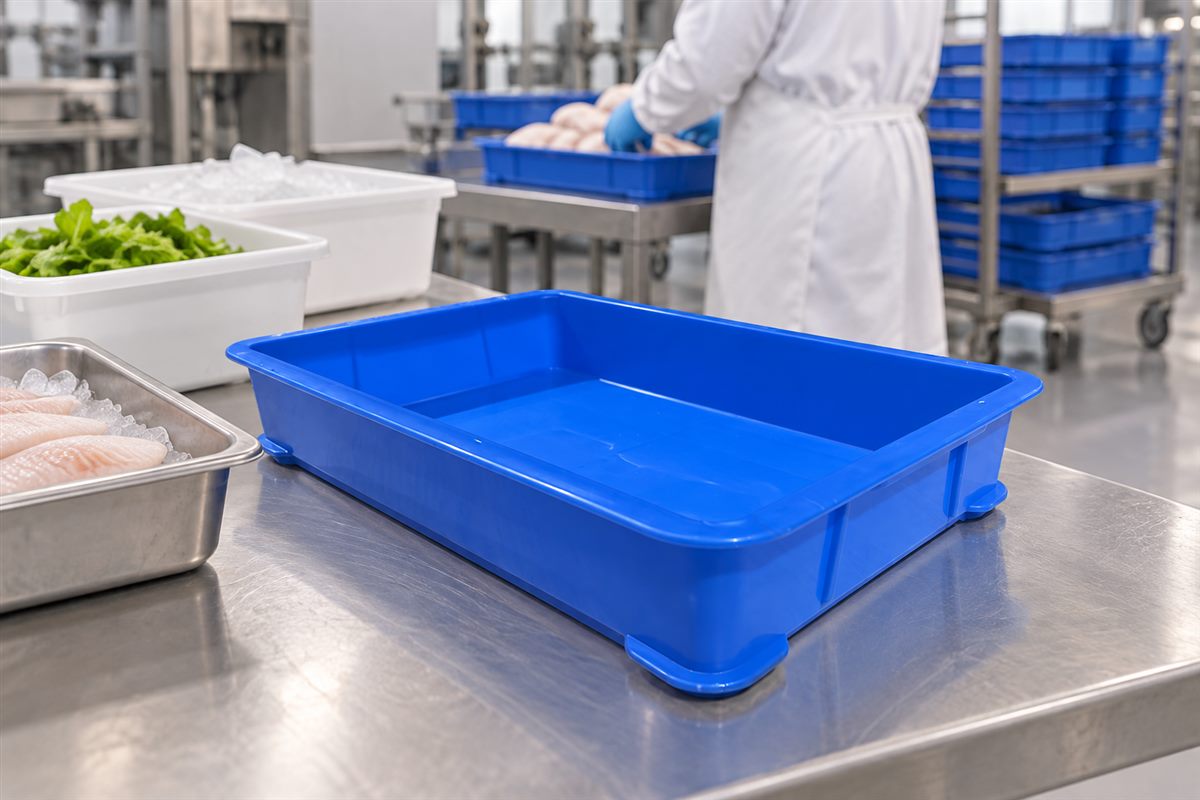
XF-7 tray in a food processing environment (AI-generated application illustration, not a customer site)
What Should a Buyer Confirm Before Ordering Plastic Food Trays?
Identify the contents and contact conditions. Tell the supplier whether the tray will hold exposed food, packaged food, ingredients, semi-finished goods, or supporting materials. These applications may involve different hygiene and handling requirements, so visual similarity alone is not enough to confirm suitability.
Check the available space. Measure the usable length, width, and height of the workstation, rack, trolley, or storage location. The XF-7 is approximately 490 × 337 × 85 mm, but sufficient clearance should be allowed for lifting and placing the tray.
Describe the handling process. Manual carrying, trolley movement, and fixed-station use create different operating conditions. A useful request for quotation should include the type of goods, estimated load per tray, transfer distance, frequency of use, and the planned cleaning process. This information helps determine whether an existing model is suitable or whether a different configuration should be discussed.
Verify performance requirements in writing. If the project involves a defined load, temperature range, special washing method, stacking arrangement, or automated conveyor, those requirements should not be inferred from a similar tray. They should be confirmed against project-specific technical information before purchase.
How to Prepare a Clear RFQ
International buyers can improve the quotation process by providing the intended contents, food-contact conditions, estimated load per tray, operating environment, handling method, required quantity, and destination. If the tray must fit existing equipment, include the usable internal dimensions of the rack, trolley, or workstation. Photos or a simple workflow drawing can also help clarify how the tray will be used.
The XF-7 food grade plastic tray can be considered for food-related turnover and internal transport. Buyers planning a food processing workstation, packaged-material sorting area, or short-distance handling route may contact Xingfeng Plastic Technology (Huizhou) Co., Ltd. with their actual operating conditions so the model and requirements can be reviewed using confirmed information.


Xingfeng is a comprehensive company integrating R & D, production and sales, specializing in manufacturing and selling plastic products widely used in industry, agriculture, animal husbandry, catering, logistics and transportation.
Quick navigation
Contact information

Add:Xingfeng Plastic Technology (Huizhou) Co., Ltd

Whatsapp:+8615118986997
Domestic hotline: 0752-6518926
Special line for foreign trade: 0752-6518922
Front desk: 0752-6518900

Email: sales2@xingfengsj.com

点击右上角
分享给朋友吧
© 2021 Xingfeng Plastic Technology (Huizhou) Co., Ltd
 客服
